

A Changing Production Culture: Why Stable Processes Are More Than Just Technology
An in-depth article on how corporate culture in manufacturing directly influences quality, stability, and growth, and why clear structures are crucial in the long term.
Gain insights into production, processes, and new developments related to sandwich panels and industrial building construction.
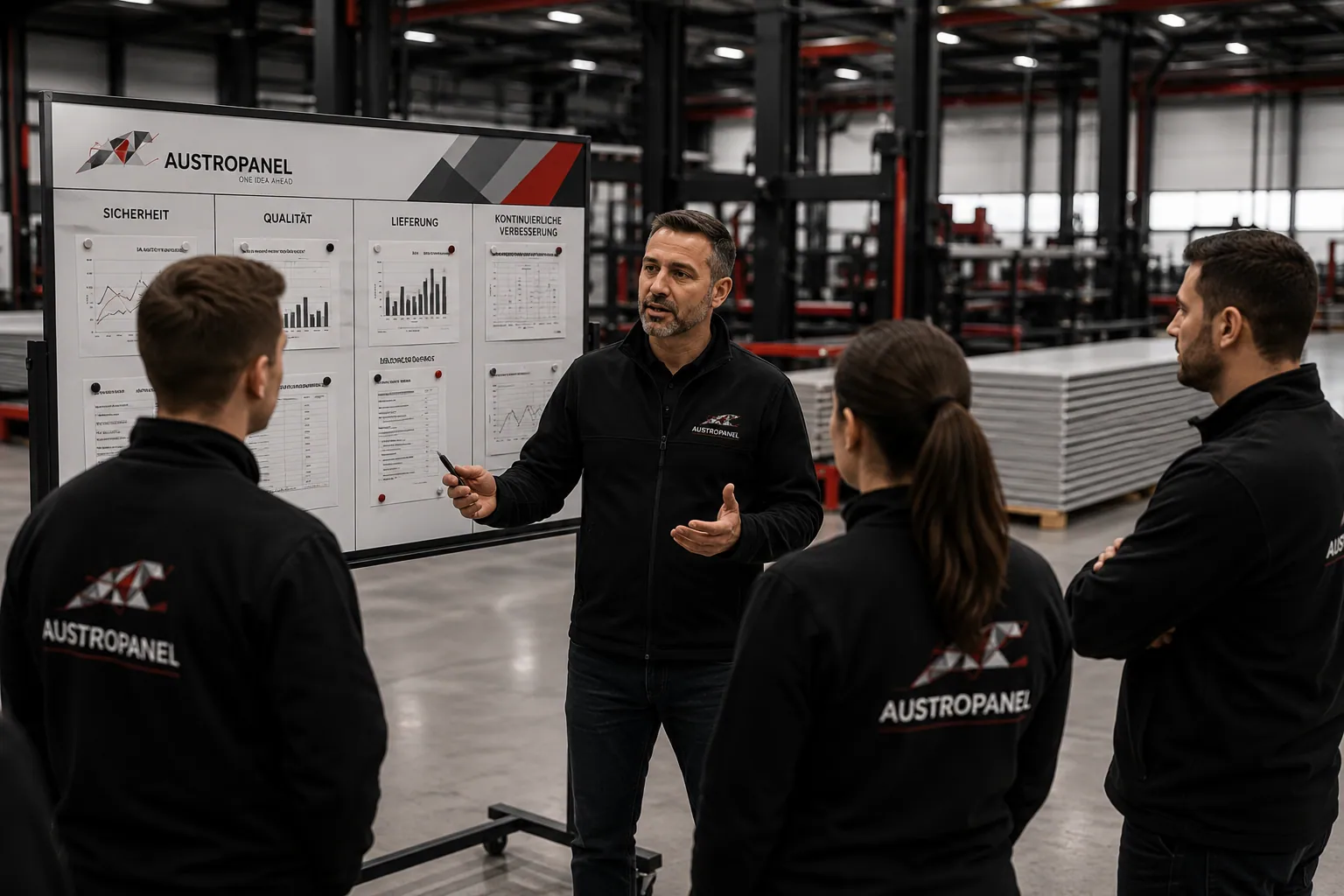
Industrial production is often defined in terms of machinery, capacity, and technical capabilities, while a crucial factor remains in the background: the culture in which this production takes place. Stable processes are not created by technology alone, but through clear structures, accountability, and a shared understanding of how work is done. Especially in growing manufacturing facilities, this foundation determines whether quality can be maintained over the long term or whether it loses stability as complexity increases.
Why production culture is crucial
In many manufacturing facilities, organizational culture is only addressed when problems arise. However, delays, quality issues, or ambiguities in processes are rarely purely technical issues; rather, they are usually indicative of a lack of structure or inconsistent work practices.
A functional production culture is not reflected in mission statements, but in day-to-day operations. It is evident in clearly defined processes, transparent decision-making, and a shared understanding of how work is done. This clarity is particularly crucial in industrial manufacturing, where many steps are interlinked.
Elements of stable production processes
- clear responsibilities throughout the entire manufacturing process
- defined procedures that do not need to be reinterpreted every time there is a deviation
- consistent quality standards within the team
- structured communication between production, engineering, and planning
These factors ensure that decisions are not made on a case-by-case basis, but are instead based on a common framework. As a result, production becomes less prone to errors and, at the same time, more scalable.
Growth increases complexity
As a business grows, its operations become more complex. New employees, additional machinery, and increasing production volumes place greater demands on coordination and collaboration. Without a solid cultural foundation, this development often leads to inefficiencies.
A clear production culture counteracts this effect by providing guidance and keeping processes stable even under changing conditions.
Conclusion
Technical equipment is a prerequisite for industrial production, but it alone is not enough to achieve consistently reliable results. What matters most is how processes are implemented and whether there is a shared understanding of quality, responsibility, and procedures within the company.
Companies that consciously develop their production culture lay the groundwork for stable processes, predictable results, and long-term growth.
.webp)

